

HS Code vs HTS Code
1. HS Code vs HTS Code: Key Takeaways
- An HS Code is a universal 6-digit system developed by the World Customs Organization (WCO) and used by more than 200 countries. It standardizes how goods are classified in international trade, ensuring consistency for tariffs, trade statistics, and regulatory compliance.
- An HTS Code, also called HTSUS in the U.S., is a 7–10 digit extension of the HS Code. While the first six digits remain the same as the HS Code, the extra digits add country-specific detail. In the U.S., it is maintained by the ITC and enforced by CBP, and it determines precise duties, tariffs, and import regulations.
- The main contrast in HS Code vs HTS Code lies in their scope and purpose. HS Codes are global and apply universally to both imports and exports, while HTS Codes are country-specific, used mainly for imports to set tariffs and fees. Together, they ensure that products are classified consistently worldwide while meeting local trade requirements.
2. What is an HS Code?
The Harmonized System (HS) Code is like a universal "language" for goods in international trade. It's a standardized set of numbers used to classify products when they're imported or exported. It was developed by the World Customs Organization (WCO) and is now used by more than 200 countries.
HS code contains a 6-digit number used in international trade to classify products. Every traded item is assigned one of these codes, which makes it easier for customs authorities around the world to know exactly what the product is, more specifically for:
- Tariffs and duties – how much tax will be applied to the item.
- Trade statistics – so governments can track imports and exports.
- Regulations – ensuring products meet safety, health, or environmental rules.
3. What is an HTS Code?
A Harmonized Tariff Schedule (HTS) code is a 7–10 digit number used by individual countries to classify imported goods in more detail. In the United States, these are called HTSUS codes and are maintained by the U.S. International Trade Commission (ITC), while Customs and Border Protection (CBP) enforces them at the border.
The first six digits of any HTS code are the standard HS code, recognized worldwide. The extra digits (up to four more) are country-specific, providing a finer level of detail. These added numbers help determine:
- The exact duty rate that applies to a product.
- Import fees or restrictions specific to that country.
- Statistical tracking of trade at a national level.
4. HS Code vs HTS Code: What Are The Differences?
At first glance, HS and HTS codes (sometimes called HTSUS in the U.S.) may look almost identical. But when we compare HS code vs HTS code, important differences appear in their definition, number of digits, how they work, who uses them, and how they're applied in trade.
4.1. Definition
The HS code (Harmonized System) is a universal classification standard developed by the World Customs Organization (WCO). It provides a consistent 6-digit framework to categorize products in international trade.
By contrast, the HTS code (Harmonized Tariff Schedule) is a country-specific extension of the HS code. For example, in the United States, a 10-digit HTSUS code is maintained by the U.S. International Trade Commission (USITC), adding more detail about tariffs and regulations.
4.2. Number of Digits
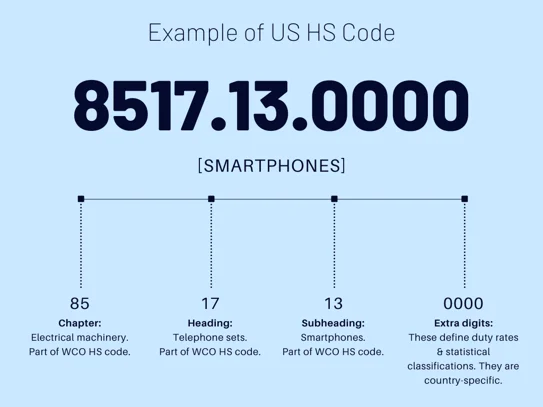
When comparing HS vs HTS code, the difference in length is the first clear distinction. An HS code is always exactly six digits, such as 6109.10 for cotton T-shirts.
 {width="652"}
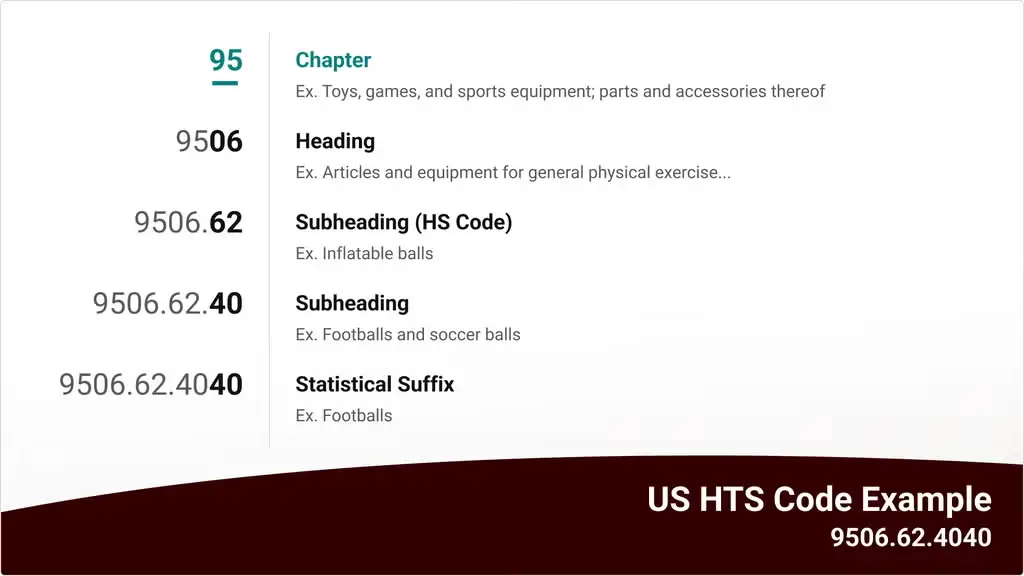
The HTS code, however, extends this structure to seven to ten digits depending on the country, with the U.S. version typically being ten digits, for example 6109.10.0012. This expansion allows local authorities to classify products with more precision.
4.3. How Each Works
The HS code functions as a global language for product classification. Every country recognizes the first six digits, which ensures uniformity in describing goods across borders.
The HTS code, on the other hand, starts with the HS base but adds extra digits that specify duties, tariffs, and compliance requirements unique to the importing country. Customs brokers must follow the General Rules of Interpretation and local regulations to apply HTS codes correctly, which makes HTS vs HS code especially relevant when shipping to different countries.
4.4. Used By
The HS code is used worldwide by exporters, importers, customs authorities, and trade organizations in more than 200 countries. Its role is to make international transactions consistent and transparent.
The HTS code is applied by national governments, such as the USITC in the United States, and is mainly used by importers, customs brokers, and compliance officers to calculate tariffs and taxes. This distinction highlights the practical difference when looking at HTS code vs HS code.
4.5. Usage in Trade
In trade processes, the HS code is used primarily for exports, statistics, and ensuring a common classification language for international shipping documents. It makes it easier for global trade data to be tracked and compared.
The HTS code, however, is most critical at the point of import, as it determines the exact duties, tariffs, and regulatory requirements applied to goods in the importing country. This shows that HS vs HTS code is not about one replacing the other but about how both operate together in global trade.
| Feature | HS Code | HTS Code |
|---|---|---|
| Full Name | Harmonized System Code | Harmonized Tariff Schedule Code |
| Governing Authority | World Customs Organization (WCO) | National governments (e.g., USITC in the U.S.) |
| Number of Digits | Always 6 digits | 7–10 digits depending on the country |
| Purpose | Standardized product classification | Defines tariffs, duties, and compliance rules |
| Used For | Global trade data, export classification | Country-specific import duties & regulations |
| Example | 6109.10 | 6109.10.0012 (U.S. HTSUS) |
5. What are Schedule B Codes & How Do They Work?
Schedule B codes are classification numbers used in the United States to track and record exports. They are closely related to HS codes, since they usually share the first six digits, but they add extra digits to give a more detailed breakdown for U.S. trade reporting.
Unlike HTS codes, which are used to calculate tariffs and duties, Schedule B codes serve a different purpose. They are maintained by the U.S. Census Bureau and are mainly used to generate export statistics. When a company ships goods out of the country, it must use a Schedule B code to classify the product. This allows the government to monitor what products are being exported, where they are going, and in what quantities.
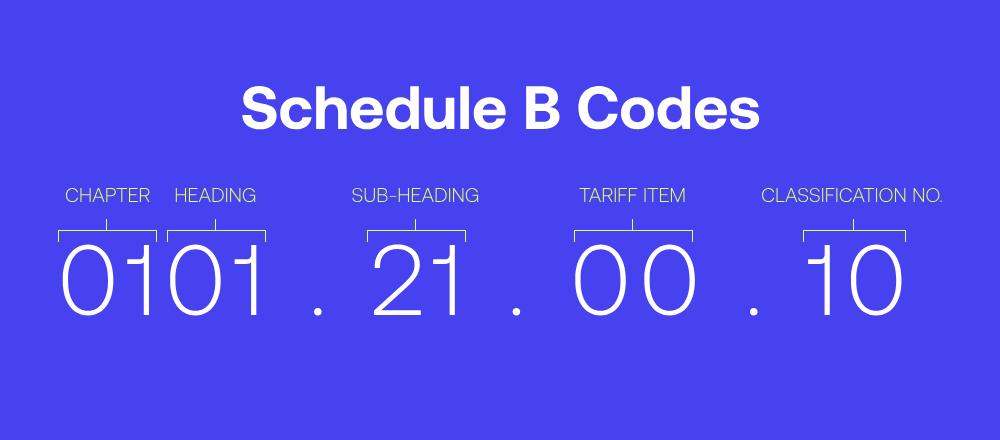
The structure works like this: the first 6 digits of a Schedule B code represent the universal HS code, while the additional digits provide more specific classification for U.S. export reporting. This extra detail helps exporters identify trends, analyze markets, and optimize their strategies.
For example, tech companies often rely on Schedule B codes to gain insights into export performance and spot new opportunities in foreign markets.
6. HTS Code vs HS Code vs Schedule B
- An HS Code is a 6-digit international standard used by over 200 countries to classify goods in global trade.
- An HTS Code (or HTSUS in the U.S.) builds on the HS Code, extending it to 7–10 digits to provide country-specific detail for imports, including tariffs, duties, and regulatory requirements; in the U.S., it is managed by the International Trade Commission and enforced by Customs and Border Protection.
- A Schedule B code, on the other hand, is a 10-digit U.S.-specific system also based on the HS framework but used solely for exports. While it does not determine duties, it plays a vital role in tracking export statistics and ensuring compliance, maintained by the U.S. Census Bureau.
In short, when comparing HS Code vs HTS Code vs Schedule B, the HS Code serves as the global foundation, the HTS Code applies national rules for imports, and the Schedule B Code focuses on monitoring U.S. exports.
7. Conclusion
Understanding the differences between HS Codes, HTS Codes, and Schedule B Codes is essential for navigating international trade. The HS Code provides the global foundation, ensuring goods are classified consistently across borders. HTS Codes add country-specific detail, determining import duties and regulatory requirements, while Schedule B Codes support U.S. export tracking and trade statistics.
For importers, exporters, and global trade companies, these systems form the backbone of how products are identified, taxed, and monitored in global commerce.
However, accurate use of these codes requires more than manual effort. That's why yTrade equips businesses with complete HS code coverage, real-time compliance updates, and AI-powered insights to ensure precise classification, correct duty calculations, and simplified global trade management.
👉 Get Started to see how yTrade stays compliant and make confident trade decisions worldwide.
Frequently Asked Questions
How to convert an HTS code to an HS code?
To convert an HTS code to an HS code, use the first six digits of the HTS code. The Harmonized System (HS) is standardized globally at six digits, while HTS codes add extra country-specific digits used to determine tariffs and import rules.
What is the HS code 4901100000?
HS code 490110 refers to printed books, brochures, leaflets, and similar printed materials in single sheets, whether folded or unfolded. The extended number 4901100000 is a country-specific tariff classification built on this HS code.
What is the HS code 903089000000?
HS code 903089 refers to instruments and apparatus used for measuring or checking electrical quantities that are not specified elsewhere in the HS classification. The longer code 903089000000 represents a more detailed national tariff classification based on this HS category.
What is HS code vs tariff code?
An HS code is a universal six-digit classification system used worldwide to identify traded products, while a tariff code is a country-specific extension of the HS code used by customs authorities to calculate duties, taxes, and import regulations.
Is HTS the same as HS code?
HTS is not the same as an HS code. The HS code is the global six-digit classification created by the World Customs Organization, while the HTS code extends those six digits with additional numbers defined by each country to determine tariffs and import requirements. Tariff codes determine import duties, taxes, and compliance rules in each country.
yTrade contributor
Recommended Reading
China Oil Imports by Country: Where Does China Get Most of Its Oil From?
China oil imports by country: Russia leads at 20.11% of US$243.6B in HS 27 fuel imports over Jan–Jul 2026, ahead of Saudi Arabia at 10.46% and Brazil at 9.89%.
Top Coffee Exporting Countries in 2026: Who Are Coffee Top Suppliers?
Coffee exporting countries in 2026: Brazil leads the world, Vietnam is second at US$4.39B, ahead of Ethiopia and Uganda in HS 0901 trade data, Jan to Jul.
What Country Exports the Most Beer? 2026 Beer Trade Data
What country exports the most beer in 2026? Mexico leads global beer trade, ahead of the Netherlands, Belgium, Germany and Vietnam, HS 2203 yTrade data.
Which Are the Top Rice Importing Countries in 2026?
Rice importing countries 2026: Tanzania leads at US$7.1B (47.24%), ahead of the Philippines (US$4.15B) and Vietnam by destination value in HS 1006 trade data.